
Menu Item "Competency Levels"
The "Competency Levels" menu item contains the tabular overview of all defined competency levels.
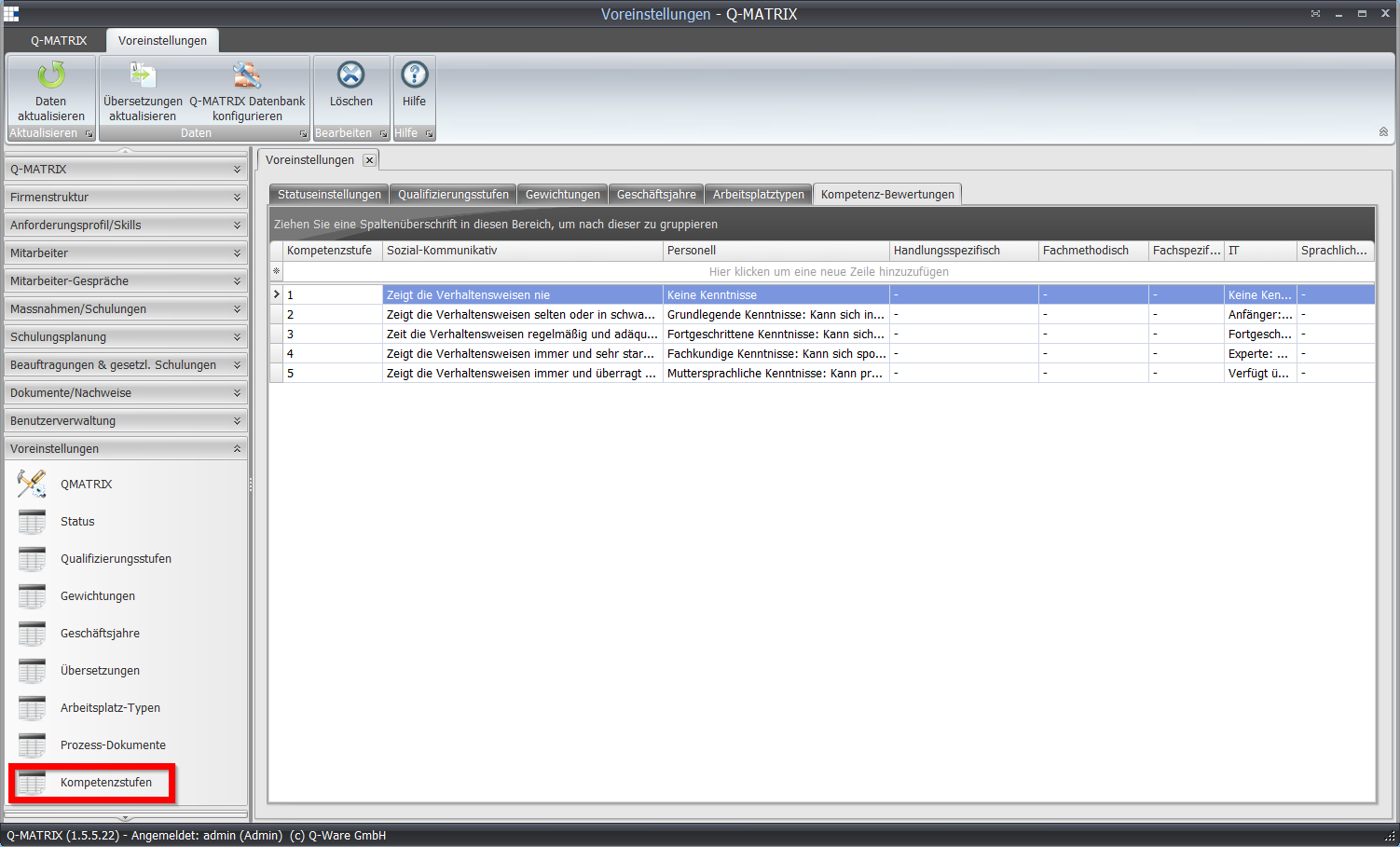
| Competency Level | Allows entry of levels, e.g. 1-5 or A-E. Only one level can be defined per row. |
| Social-Communicative | Abilities that serve the exchange of information and mutual understanding, as well as being suited to building, shaping, and maintaining social relationships.
The following list (not exhaustive) gives insight into this topic:
| Teamwork/Team Orientation | Finding one's own role within groups in a way that makes a valuable contribution to the group's goal. |
| Team/Project Management | Setting up projects and leading (project) teams. |
| Sensitivity | Openness to the feelings and needs of other people and the ability to respond to them appropriately. |
| Intercultural Sensitivity | Acting within a foreign cultural environment and finding one's way despite possible obstacles. |
| Persuasiveness | Presenting one's own plans and viewpoints so that other people understand, judge, share, and adopt them in the same way. |
| Assertiveness | Implementing one's own goals and ideas even against the resistance of others, arguing convincingly, and - even when facing resistance - not giving in immediately. |
Examples:
- 1 - Never shows the behaviors
- 2 - Rarely shows the behaviors or shows them weakly
- 3 - Shows the behaviors regularly and to an adequate degree
- 4 - Always shows the behaviors, and very strongly
- 5 - Always shows the behaviors and exceeds expectations
|
| Personal | Groups soft skills primarily directed at oneself. These include, among other things, personal work techniques that significantly determine the personal effectiveness and efficiency of each individual.
The following list (not exhaustive) shows some content for this topic:
| Adaptability | I can adjust to changed conditions and cope well with changing situations. I respond appropriately to new challenges; I can fit well into new teams. |
| Presence | I can present myself confidently, credibly, and convincingly according to the situation. I know my personal impact and can consciously use it for a successful presentation. |
| Authenticity | Due to my natural behavior, I am a credible and respectable person to those around me. I neither avoid certain situations nor pretend to be someone else with others; I always try to be myself. |
| Assertiveness | I can confidently represent an independent opinion that differs from others while arguing plausibly. I can also develop strategies to assert my position, even against the interests of others. |
| Personal Responsibility | I know that I am responsible for my own life and decisions. This also means that every situation in my life is decisively shaped by my actions. |
| Flexibility | I can adapt my usual thinking and actions to new, changed situations. I can also take on new tasks and challenges and deal with them without fear. |
| Creativity | I enjoy experimenting and am willing to try new paths. I can develop unconventional, unusual new ideas and implement them accordingly. I am resourceful, have imagination, and enjoy trying new things. |
| Willingness to Learn | I am open to new things and learn from my successes as well as my failures. I have great interest in new developments and information, and I can acquire new knowledge and skills within a reasonable period. |
Examples:
- 1 - No knowledge
- 2 - Basic knowledge: Can communicate in simple, routine situations involving a simple and direct exchange of information about familiar and common things
- 3 - Advanced knowledge: Can express oneself simply and coherently about familiar topics and personal areas of interest. Can report on experiences and events and give brief reasons or explanations for plans and views.
- 4 - Proficient knowledge: Can express oneself spontaneously and fluently without often needing to visibly search for words. Can express oneself clearly, in a structured way, and in detail on complex matters, using various means of text cohesion appropriately
- 5 - Native-level knowledge: Can understand practically everything read or heard effortlessly. Can express oneself spontaneously, very fluently, and precisely, making finer nuances of meaning clear even in more complex matters.
|
| Action-Specific | A person's action competence is their personal ability to act purposefully and appropriately to the task. This competence refers not only to the ability to act, but also incorporates learned knowledge, social norms, and logical considerations. The stronger this competence is developed, the more thoughtful, efficient, and responsible the decisions and actions that arise from considerations and deliberations can be.
Action competence is composed of four other competencies. The following list (not exhaustive) shows some content for this topic:
| Personality Competence | ... can be seen as the ability for will and reflection. |
| Social Competence | ... describes the ability to find one's way within a social structure, communicate with it at an appropriate level, and adhere to social rules. |
| Methodological Competence | ... refers to the ability to actually carry out a solution approach. |
| Professional Competence | ... is composed primarily of subject-related theoretical and practical knowledge. |
Examples:
- 1 - No knowledge
- 2 - Basic knowledge
- 3 - Advanced knowledge
- 4 - Proficient knowledge
- 5 - Expert knowledge
|
| Methodological | Knowledge and abilities to apply methods in a way that effectively and comprehensively achieves action goals. The KomPass refers to the following methodological competencies.
The following list (not exhaustive) shows some content for this topic:
| Work Techniques | Procedures and strategies that make personal work easier and more efficient. |
| Presentation Techniques | Preparation, structure, and design of a presentation, including the use of suitable media, so that the audience understands and finds the content and manner of delivery interesting. |
| Facilitation | An approach to goal- and result-oriented leadership of working groups and meetings. |
| Problem Solving | Addressing problems comprehensively, quickly, and with as little effort as possible, and taking suitable measures to resolve them. |
| Creativity Techniques | Strategies and techniques suited to generating innovative ideas. |
| Time Management | Allocating one's own time budget so that goals can be achieved comprehensively and effectively. |
| Self-Marketing | Presenting oneself favorably and yet realistically in professionally relevant situations, as well as the ability to build networks for one's individual career. |
Examples:
- 1 - No knowledge
- 2 - Basic knowledge
- 3 - Advanced knowledge
- 4 - Proficient knowledge
- 5 - Expert knowledge
|
| Subject-Specific | Professional competence refers to the ability required to deal with material matters, which, in addition to theoretical knowledge, also includes practically applicable operational knowledge and requires intellectual as well as manual skills and abilities.
The following list (not exhaustive) shows some content for this topic:
| Professional Skills | For example, foreign languages, laws, written expression |
| Professional Knowledge | For example, instruments, machines |
| Professional Commitment | For example, endurance, environmental awareness |
Examples:
- 1 - No knowledge
- 2 - Basic knowledge
- 3 - Advanced knowledge
- 4 - Proficient knowledge
- 5 - Expert knowledge
|
| IT | The ability to use the computer for areas such as
- Basic IT knowledge and skills
- Computer- and information-related competencies
- Media practice/media use
- Media literacy
Examples:
- 1 - No knowledge
- 2 - Beginner: Has basic knowledge
- 3 - Advanced: Has differentiated knowledge and diverse experiential knowledge
- 4 - Expert: Has broad and deep knowledge and application experience from different contexts
- 5 - Has expert knowledge, can prepare it and make it available to other people. Contributes to shaping programs.
|
| Language Competence | Language competence refers to both colloquial competence and, from a learning-psychology perspective, knowledge and proficiency in one or more languages.
Examples:
- 1 - No knowledge
- 2 - Basic knowledge
- 3 - Advanced knowledge
- 4 - Proficient knowledge
- 5 - Native-level knowledge
|


